
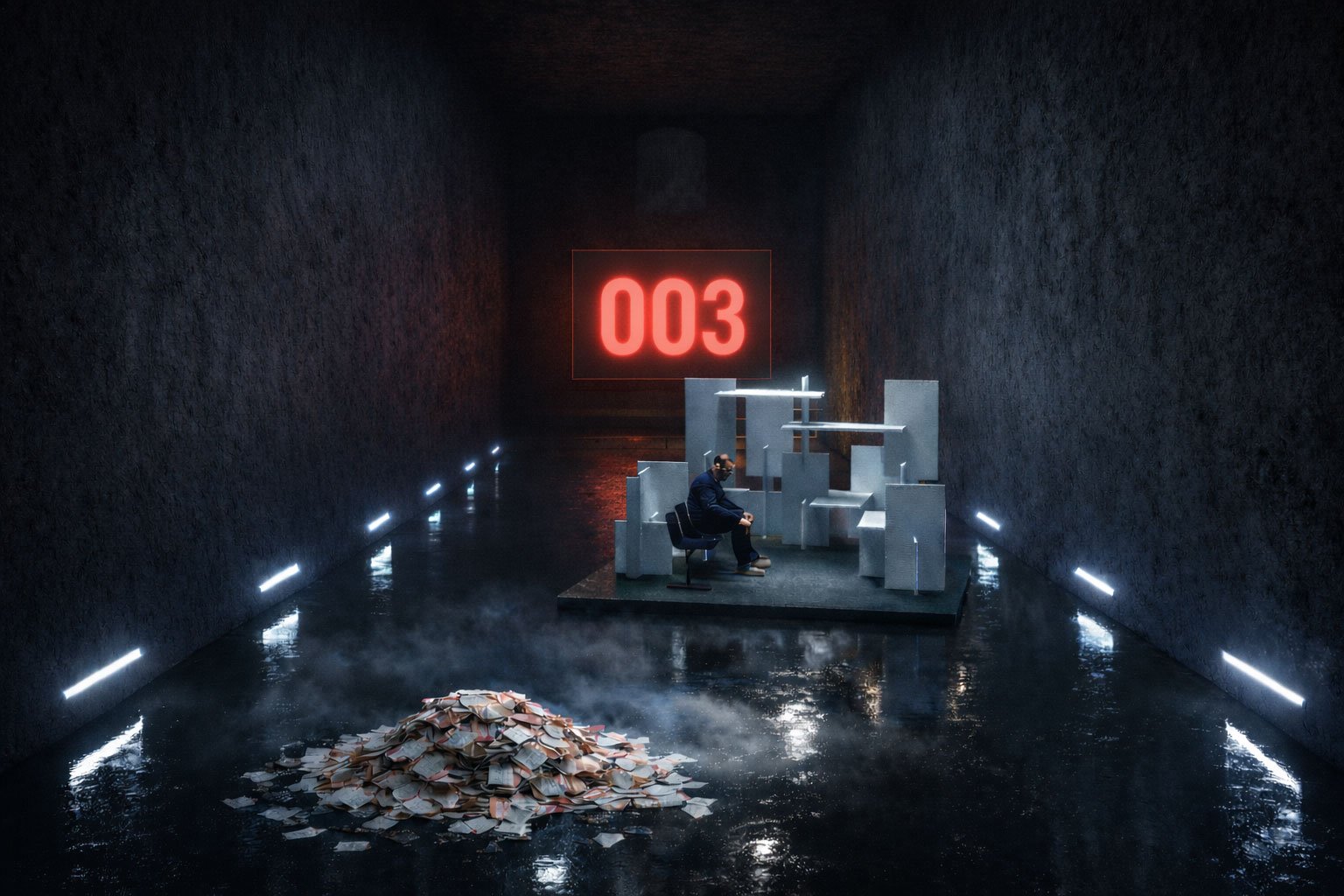
Waiting Room (Domesticated)
jan 16, 2026 — 6.30pm
jan 30, 2026 — 7.30pm
Waiting Room (Domesticated) begins with friction. A space as regulated as the waiting room is overlaid with the term domesticated—a word that implies closeness without hospitality, intimacy without ease. The bracket does not simply frame; it restrains. It encloses, compresses, imposes order. In this tightened space, care slides into surveillance until the two can no longer be told apart. What is meant to receive instead reiterates the rule; what is meant to soothe quietly enforces a new discipline. The proximity produced here is unstable, permanently at risk of rupture. What emerges is a constant pull between accommodation and resistance, between being looked after and being conditioned. What does it mean to domesticate a waiting room?
The project by Yaroslav Krivchenkov, Che Facchin and Dato Ebrialidze translates the tension into space, reworking the rooms of Spazio Punch as a waiting room. Cold neon lines run along the walls; modular surfaces articulate the environment; numerical displays light up yet never advance. The elements recall a language of functional architecture that is immediately recognisable and at the same time estranged, emptied of its promise of efficiency. The installation alters the experience of time, extending duration and giving form to a suspended, self-contained temporality. A time without direction or resolution, which does not lead forward but slowly accumulates, thickens and adheres to the bodies that move through it. The waiting room no longer functions as a site of transition; it emerges as a persistent condition—a temporal environment that holds, delays and expands.
The stillness that takes hold is deceptive. Beneath the space’s apparent stasis, a low-level vibration sets in. Bodies generate small departures: postures that slip beyond their prescribed use, weight subtly redistributed, distances tightening or stretching too far. Nothing here resolves into a story or tips over into an event. There is no progression, no visible shift. These movements work instead as disruptions—minor glitches that unsettle the room’s operational logic and strain its disciplinary framework. In these almost unnoticeable departures, the space begins to lose its grip, and waiting is stripped of its functional opacity, exposed by bodies that never fully comply.
Che Facchin is a Swiss scenographer who works across art and architecture. His works include the Miu Miu FW25 show as part of AMO and a series of projects with MOTHERLODE.
Yaroslav Krivchenkov is a Venice-based architect and designer. His work includes architectural and exhibition projects at OMA and he is currently conducting scenographic research at IUAV.
Dato Ebrialidze is a Georgian architect and designer working at the intersection of architecture and fashion. His practice extends into exhibitions in Venice, continually rethinking material, form and fabric.
To mark the opening, Spazio Punch will host live sets by J Lamb and Delta Division, artists affiliated with the Berlin-based label Fear of Silence, founded by Delta Division and visually curated by Diego De Lazzer. Drawing on club culture and bass music aesthetics, the label’s sonic research focuses on deep frequencies, driving rhythms and listening experiences conceived for the collective space of the dancefloor.
Idea and set up by Yaroslav Krivchenkov, Che Facchin and Dato Ebrialidze
Creative Director: Augusto Maurandi
Vibe researcher: Alessia Prati
Graphic support: Hstudio
OPENING
January 16, 2026
Performance, from 6.30 PM
Dj set by J Lamb and Delta Division, 9 PM (info)
SECOND SHOWING • DOCUMENTATION SESSION
January 30, 2026
Performance, from 7.30 PM
IT Waiting Room (Domesticated) nasce da una frizione. Su un’architettura prescrittiva come quella della sala d’attesa si innesta domesticated, una parola equivoca che avvicina senza accogliere, attivando una prossimità tesa. La parentesi protegge, trattiene, comprime, disciplina. Un dispositivo di contenimento che riduce la distanza senza annullare il controllo. In questo spazio contratto, cura e sorveglianza collassano l’una nell’altra, diventando indistinguibili. Ciò che dovrebbe accogliere rinnova la regola, ciò che dovrebbe rassicurare finisce per imporre una nuova forma. La vicinanza che ne deriva resta instabile, sempre sul punto di cedere. Una tensione continua tra adattamento e resistenza, tra l’essere ospitati e l’essere addestrati. Cosa accade quando si addomestica una sala d’attesa?
L’intervento di Yaroslav Krivchenkov, Che Facchin e Dato Ebrialidze rilegge gli ambienti di Spazio Punch riconfigurandoli come una waiting room essenziale. Neon freddi corrono lungo le pareti, superfici modulari scandiscono lo spazio, display numerici si accendono senza mai avanzare. Ogni elemento rimanda a un’architettura funzionale, familiare e al tempo stesso estranea, svuotata della sua promessa di efficienza. L’installazione genera una percezione dilatata della durata, la materializzazione di un tempo autonomo, sospeso, privo di progressione e di risoluzione. Un tempo che non conduce, che lentamente si accumula, si ispessisce, aderendo ai corpi che lo attraversano. La waiting room smette di essere un luogo di passaggio e si manifesta come una condizione persistente, un ambiente temporale che trattiene e dilata.
L’immobilità che ne deriva è solo apparente: sotto la superficie statica dello spazio, una vibrazione sottile prende forma. Micro-scarti prodotti dai corpi — posture che eccedono la funzione assegnata, pesi che si spostano, distanze che si accorciano o si tendono oltre misura. Questi movimenti non costruiscono una narrazione né introducono un evento, non promettono sviluppo né trasformazione visibile. Agiscono piuttosto come interferenze, glitch che incrinano l’ordine operativo della sala, mettendo in crisi la sua grammatica disciplinare. È in queste deviazioni impercettibili che lo spazio perde stabilità e l’attesa perde la sua opacità funzionale, esposta dall’eccedenza dei corpi che non vi aderiscono del tutto.
Che Facchin è uno scenografo svizzero che lavora tra arte e architettura. Tra i suoi lavori figurano la sfilata Miu Miu FW25 come parte di AMO e una serie di progetti realizzati con MOTHERLODE.
Yaroslav Krivchenkov è un architetto e designer con base a Venezia. Il suo lavoro comprende progetti architettonici ed espositivi presso OMA; attualmente conduce una ricerca scenografica presso IUAV.
Dato Ebrialidze è un architetto e designer georgiano che opera all’intersezione tra architettura e moda. La sua pratica si estende a progetti espositivi a Venezia, in una continua rielaborazione di materiali, forme e tessuti.
In occasione dell’opening, Spazio Punch ospita i live set di J Lamb e Delta Division, artisti dell’etichetta berlinese Fear of Silence, fondata da Delta Division e curata visivamente da Diego De Lazzer. Radicata nella cultura club e nelle estetiche della bass music, Fear of Silence sviluppa una ricerca sonora focalizzata su frequenze profonde, dinamiche ritmiche incisive e su un’esperienza d’ascolto pensata per lo spazio condiviso del dancefloor.
Idea and set up by Yaroslav Krivchenkov, Che Facchin and Dato Ebrialidze
Creative Director: Augusto Maurandi
Vibe researcher: Alessia Prati
Graphic support: Hstudio
OPENING
16 gennaio 2026
Performance dalle 18.30
Dj set by J Lamb e Delta Division dalle 21 (info)
SECONDA REPLICA • SESSIONE DI DOCUMENTAZIONE
30 gennaio 2026
Performance dalle 19.30